
Key Points
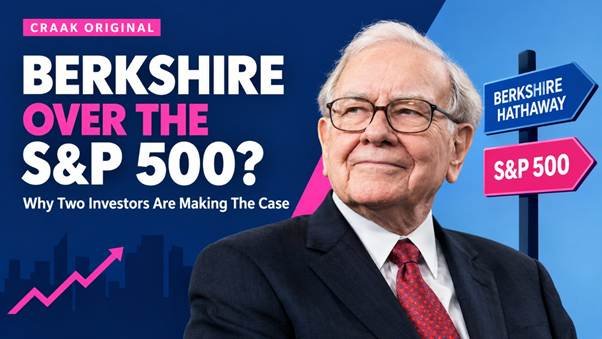
- Singapore investing writer Willie Keng argues that Berkshire Hathaway offers an alternative to an increasingly technology-heavy S&P 500.
- Value investor Mohnish Pabrai believes the S&P 500 could deliver average annual returns of between −2% and +2% over the next decade.
- Berkshire’s historical gains have been extraordinary, but its performance in recent years shows why past success doesn’t guarantee future outperformance.
Could a stock lose 99% of its value and still outperform the S&P 500?
That’s the striking comparison Singapore investing writer Willie Keng makes in an October 6 article published on his website, Dividend Titan.
The stock is Berkshire Hathaway, the conglomerate built by Warren Buffett.
According to Berkshire’s 2025 annual report, its shares delivered a cumulative gain of 6,099,294% from the end of 1964 through 2025, compared with 46,061% for the S&P 500, including dividends.
Put another way, even if Berkshire’s end-2025 share value were hypothetically reduced by 99%, its cumulative return since the end of 1964 would still exceed the index’s return over the same period.
The comparison illustrates the scale of Berkshire’s historical outperformance. It is not a prediction of a share-price collapse or evidence that Berkshire will outperform from here.
Why Keng Stopped Buying The S&P 500
Keng says he initially invested his son’s savings in an S&P 500 exchange-traded fund because it offered a straightforward way to build wealth over time.
But he has since stopped buying the index.
In his Dividend Titan analysis, Keng argues that the S&P 500 has become too expensive and that its performance is increasingly dependent on large technology companies.
He prefers Berkshire’s combination of publicly listed investments and wholly owned operating businesses.
Berkshire’s investments include companies such as Apple, American Express, Coca-Cola and Bank of America. Its operating businesses span insurance, railroads, energy and other industries.
Keng believes this provides exposure to a broader mix of businesses than an index whose returns are increasingly influenced by its largest technology stocks.
That is his investment assessment, rather than proof that Berkshire is more diversified or less risky than the S&P 500.
Keng also discloses that he owns Berkshire shares.
Pabrai Warns Of A Weak Decade
Value investor Mohnish Pabrai has separately questioned whether the S&P 500 is an attractive investment at current valuations.
In a July 21 interview with Brandon van der Kolk of New Money, Pabrai said he regarded the index as overheated.
Although he generally supports long-term index investing, Pabrai suggested Berkshire’s Class B shares as an alternative for investors concerned about current S&P 500 valuations.
He described Berkshire as a potential substitute for an index investment, rather than a conventional stock-picking opportunity.
In a separate interview with informo, Pabrai went further, saying he would not be surprised if the S&P 500 delivered average annual returns of between −2% and +2% over the next 10 years.
Pabrai pointed to earlier periods when US stocks experienced extended stretches of weak returns, arguing that high starting valuations can weigh on future performance.
He suggested considering Berkshire as an alternative to the S&P 500 for roughly the next decade, expressing the view that the index could offer a more attractive opportunity around 2035.
But Pabrai was making a forecast, not presenting a certainty. He also acknowledged that index funds can be an effective long-term investment strategy.
His concern is specifically about the S&P 500’s valuation in 2026.
But Berkshire Hasn’t Always Won
Berkshire’s long-term record is exceptional, but its more recent performance provides an important counterpoint.
In 2025, Berkshire shares gained 10.9%, while the S&P 500 returned 17.9%, including dividends.
The index also outperformed Berkshire in 2023, returning 26.3% against Berkshire’s 15.8%.
Those figures come directly from Berkshire’s published performance table. They show why a company’s historical lead does not necessarily translate into better returns over every investment period.
Berkshire Hathaway
There is another important distinction: Berkshire is not the S&P 500.
An S&P 500 fund holds shares in hundreds of listed US companies, with larger companies carrying greater weight in the index.
Berkshire is a single listed conglomerate. Its shareholders are exposed to the performance of its operating businesses, its investment portfolio and management’s decisions about how to allocate capital.
That introduces company-specific risks that an index investor does not face to the same degree.
Berkshire has also undergone a significant leadership transition. Greg Abel succeeded Buffett as chief executive, while Buffett remains chairman, as confirmed in the company’s 2025 annual report.
Berkshire Hathaway
What Singapore Investors Should Consider
Keng and Pabrai arrive at a similar conclusion: they favour Berkshire over the S&P 500 at current valuations.
But their reasoning should not be confused with a guarantee of better returns.
Keng’s argument is built around Berkshire’s historical record and its mix of businesses. Pabrai’s case rests more heavily on his concern that today’s S&P 500 valuation could constrain returns over the next decade.
Neither argument establishes what Berkshire or the index will return in the future.
For Singapore investors, there is also currency exposure to consider. Berkshire shares are denominated in US dollars, as are many S&P 500 investments. A strengthening Singapore dollar against the US dollar could reduce gains when converted back into local currency, while a weakening Singapore dollar could have the opposite effect.
Ultimately, the choice is between two different approaches: owning a broad US stock-market index or investing in a conglomerate whose management makes capital allocation decisions on shareholders’ behalf.
Keng and Pabrai prefer Berkshire. Whether they are right will only become clear over time.
Watch The Interviews
Mohnish Pabrai — New Money
Pabrai discusses why he considers the S&P 500 overvalued and suggests Berkshire Hathaway’s Class B shares as an alternative. Watch on YouTube
Mohnish Pabrai — informo
Pabrai explains his forecast for the S&P 500 over the next decade and his preference for Berkshire. Watch on YouTube